









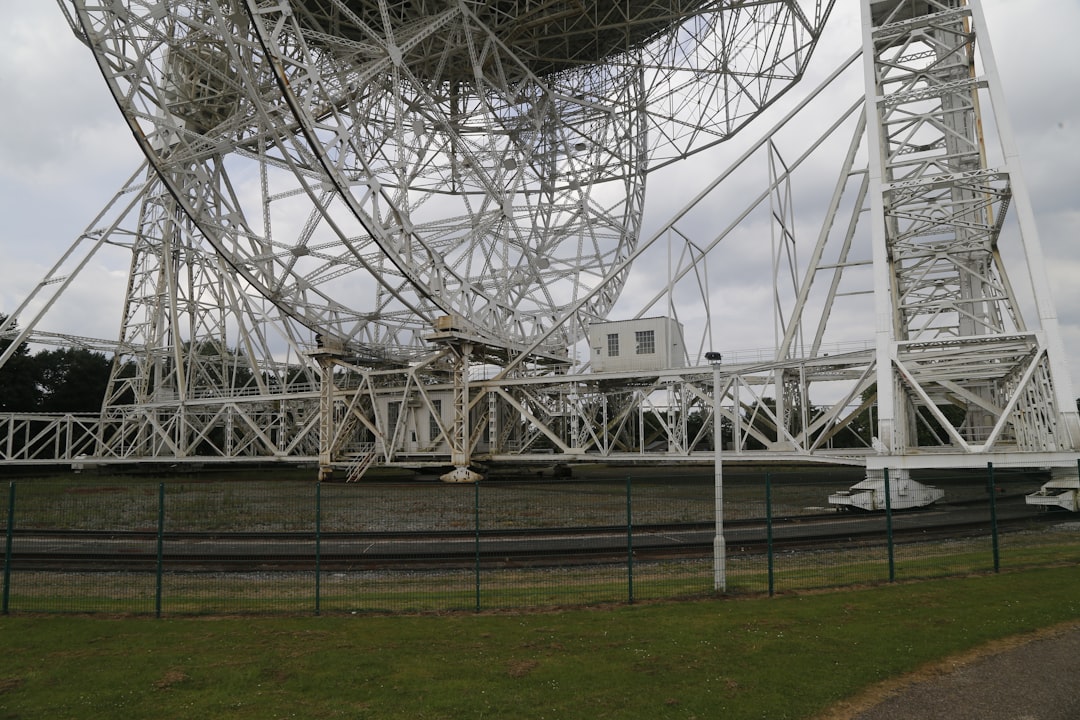
Radio astronomy has a fascinating history that dates back to the mid-20th century. The field emerged from the intersection of radio technology and astronomy, primarily during World War II when radar technology was developed.
The first significant breakthrough came in 1931 when Karl Jansky, an engineer at Bell Telephone Laboratories, discovered radio waves emanating from the Milky Way.
His work laid the groundwork for the field, although it took several years for the scientific community to recognize the significance of his findings.
Following Jansky’s discovery, the 1940s and 1950s saw rapid advancements in radio telescope technology. In 1945, Grote Reber built the first dedicated radio telescope in his backyard in Illinois, marking a pivotal moment in the field. His efforts led to the creation of a new branch of astronomy that could observe celestial phenomena beyond the visible spectrum. By the late 1950s, radio astronomy had gained traction, with institutions like the National Radio Astronomy Observatory (NRAO) being established to further research and development. This period set the stage for a deeper understanding of cosmic events and structures.
Radio astronomy has significantly advanced our understanding of the universe, allowing scientists to explore celestial phenomena that are invisible to the naked eye. For those interested in the intricate dynamics of celestial bodies, a related article that delves into the concepts of iteration, orbits, and types of orbits in dynamical systems can provide valuable insights. You can read more about these fascinating topics in the article available at Understanding Iteration, Orbits, and Types of Orbits in Dynamical Systems.
Key Takeaways
- Radio astronomy has a rich history dating back to the early 20th century, with key milestones including the discovery of cosmic radio waves and the development of radio telescopes.
- Radio astronomy plays a crucial role in understanding the universe by allowing scientists to study celestial objects and phenomena that are not visible in other wavelengths, such as pulsars, quasars, and the cosmic microwave background radiation.
- Radio telescopes work by collecting and amplifying radio waves from space, then converting them into electrical signals that can be analyzed and interpreted by scientists.
- Important discoveries made through radio astronomy include the detection of the first pulsar, the mapping of the cosmic microwave background radiation, and the identification of supermassive black holes at the centers of galaxies.
- Radio astronomy has a significant impact on cosmology by providing valuable data for studying the large-scale structure of the universe, the evolution of galaxies, and the nature of dark matter and dark energy.
The Importance of Radio Astronomy in Understanding the Universe
Radio astronomy plays a crucial role in our quest to understand the universe. Unlike optical telescopes that rely on visible light, radio telescopes can detect emissions from celestial objects that are often invisible to the naked eye. This capability allows astronomers to study phenomena such as pulsars, quasars, and cosmic microwave background radiation, which provide insights into the universe’s origins and evolution.
One of the most significant contributions of radio astronomy is its ability to probe regions of space obscured by dust and gas. For instance, radio waves can penetrate dense clouds that block visible light, enabling scientists to observe star formation and other processes occurring in these hidden areas. This unique perspective has led to groundbreaking discoveries about the lifecycle of stars and the dynamics of galaxies, enriching our understanding of cosmic evolution.
How Radio Telescopes Work
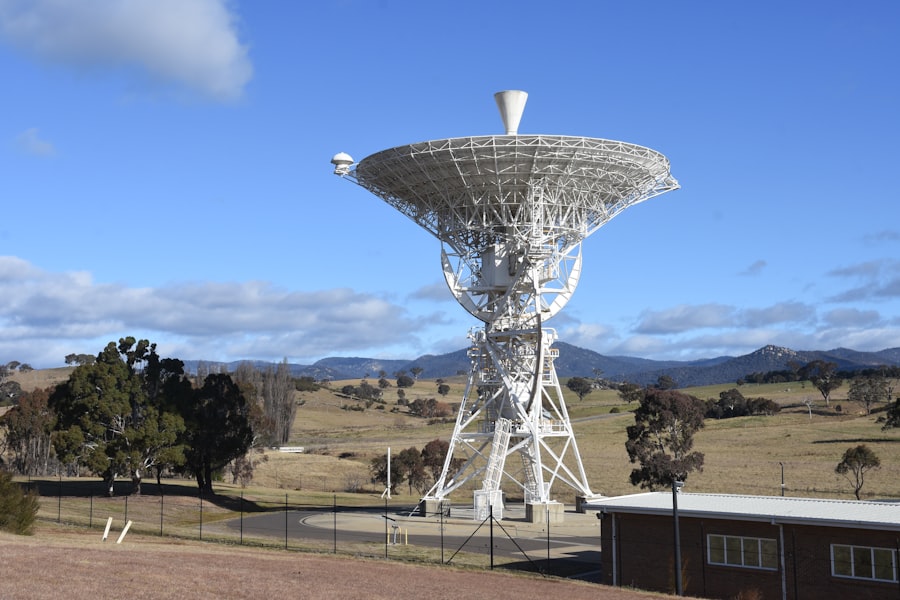
Radio telescopes operate on principles similar to those of optical telescopes but are designed to capture radio waves instead of light. At their core, they consist of a large dish that collects incoming radio signals and focuses them onto a receiver. The dish’s size is crucial; larger dishes can capture weaker signals from distant sources, enhancing sensitivity and resolution.
Once the radio waves are collected, they are converted into electrical signals by the receiver. These signals are then processed using sophisticated software that analyzes their frequency and intensity. This data can reveal a wealth of information about the source of the emissions, including its composition, distance, and motion.
The ability to convert radio waves into interpretable data is what makes radio telescopes such powerful tools for astronomers.
Discoveries Made Through Radio Astronomy
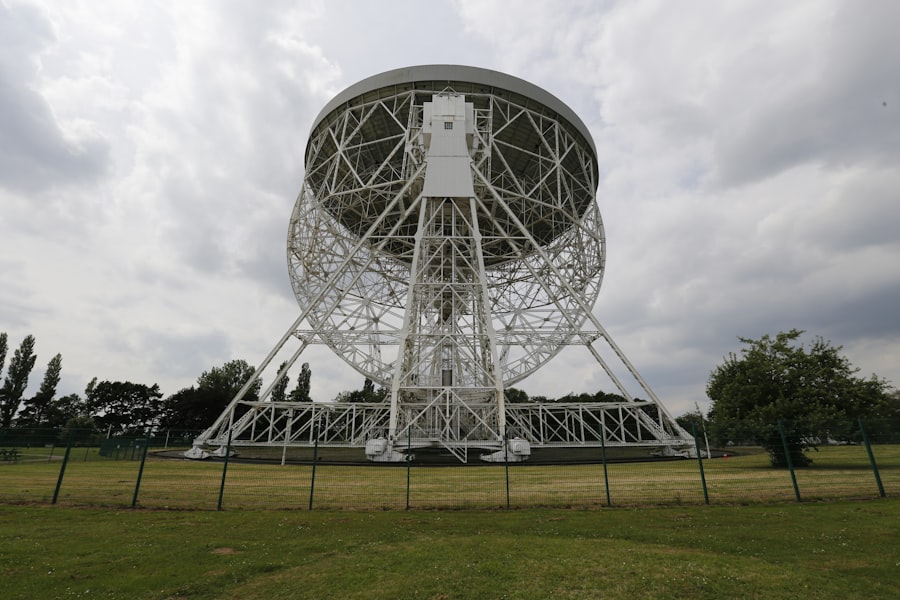
The field of radio astronomy has led to numerous groundbreaking discoveries that have reshaped our understanding of the universe. One notable example is the discovery of pulsars in 1967 by Jocelyn Bell Burnell and Antony Hewish. These rapidly rotating neutron stars emit beams of radiation that sweep across space like lighthouse beams. Their detection provided evidence for the existence of these exotic stellar remnants and opened up new avenues for research into stellar evolution.
Another significant discovery was made in 1974 when astronomers detected quasars—extremely bright and distant objects powered by supermassive black holes at the centers of galaxies. Quasars challenged existing theories about galaxy formation and evolution, prompting scientists to reconsider their models of cosmic structure. Additionally, radio astronomy has played a vital role in mapping the cosmic microwave background radiation, which offers clues about the early universe and supports the Big Bang theory.
Radio astronomy has significantly advanced our understanding of the universe, allowing scientists to study celestial phenomena through the detection of radio waves. This field has opened new avenues for research, particularly in understanding the dynamics of cosmic events. For those interested in the mathematical foundations that underpin these observations, a related article discusses the Newtonian approximation of relativistic equations of motion and the Einstein field equation. You can explore this fascinating connection further by visiting this article.
The Role of Radio Astronomy in Cosmology
| Metrics | Data |
|---|---|
| Number of Radio Telescopes Worldwide | Over 300 |
| Frequency Range of Radio Astronomy | 3 kHz to 300 GHz |
| First Radio Source Discovered | Cygnus A in 1946 |
| Largest Radio Telescope | Five-hundred-meter Aperture Spherical Telescope (FAST) in China |
Radio astronomy is integral to cosmology, the study of the universe’s origin, evolution, and eventual fate. By observing cosmic microwave background radiation, astronomers can glean information about the universe’s age, composition, and expansion rate. This radiation is a remnant from the Big Bang and serves as a snapshot of the universe when it was just 380,000 years old.
Moreover, radio telescopes help researchers study dark matter and dark energy—two mysterious components that make up most of the universe’s mass-energy content. By analyzing how galaxies cluster and move under gravitational influence, scientists can infer the presence of dark matter. Similarly, observations of distant supernovae have provided evidence for dark energy’s role in accelerating cosmic expansion. These insights are crucial for developing a comprehensive understanding of cosmological models.
Current and Future Developments in Radio Astronomy
The field of radio astronomy is continuously evolving with advancements in technology and methodology. Current developments include projects like the Square Kilometre Array (SKA), which aims to be one of the largest and most sensitive radio telescopes ever built. Once operational, it will significantly enhance our ability to study cosmic phenomena across vast distances and time scales.
Future developments also include improvements in data processing techniques and artificial intelligence applications in analyzing vast datasets generated by radio telescopes. Machine learning algorithms can help identify patterns and anomalies in data that may lead to new discoveries.
As technology progresses, we can expect even more sophisticated instruments that will push the boundaries of what we know about the universe.
Challenges and Limitations of Radio Astronomy
Despite its many advantages, radio astronomy faces several challenges and limitations. One significant issue is interference from terrestrial sources, such as cell phones and Wi-Fi signals, which can contaminate data collected by radio telescopes. To mitigate this problem, observatories often operate in remote locations away from urban areas where radio frequency interference is minimal.
Another challenge is related to the sheer volume of data generated by modern radio telescopes. As instruments become more sensitive and capable of capturing more information, processing this data becomes increasingly complex. Researchers must develop efficient algorithms and computing resources to analyze these large datasets effectively.
The Future of Radio Astronomy: Potential for New Discoveries
Looking ahead, the future of radio astronomy holds immense potential for new discoveries that could reshape our understanding of the universe. As technology continues to advance, we may uncover new celestial phenomena that challenge existing theories or provide insights into previously unexplored areas of astrophysics.
For instance, ongoing research into fast radio bursts (FRBs)—brief but intense bursts of radio waves—could reveal new information about cosmic events or even hint at extraterrestrial intelligence. Additionally, as we refine our observational techniques and expand our array of instruments, we may gain deeper insights into dark matter, dark energy, and other fundamental questions about our universe.
In conclusion, radio astronomy has come a long way since its inception in the early 20th century. Its contributions to our understanding of cosmic phenomena are invaluable, providing unique insights that complement traditional optical observations. As we look to the future, continued advancements in technology promise exciting possibilities for uncovering new mysteries in our ever-expanding universe.








+ There are no comments
Add yours