








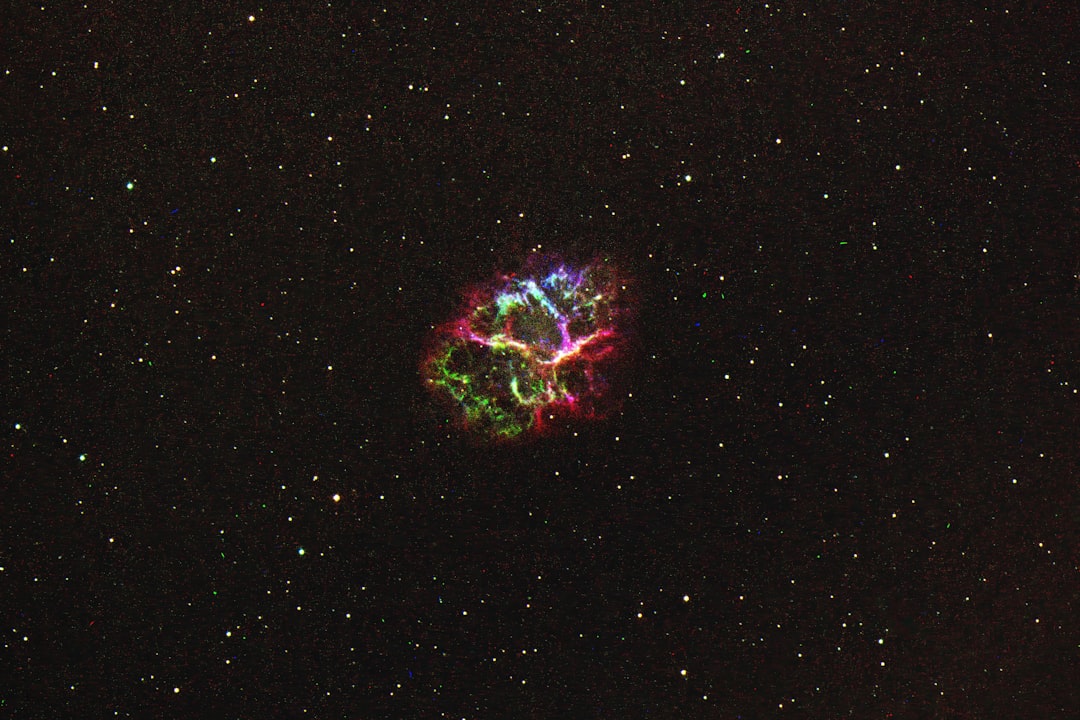
A magnetar is a type of neutron star formed from the dense remnant of a massive star following a supernova explosion. Magnetars are distinguished from other neutron stars by their exceptionally powerful magnetic fields, which are approximately 1,000 times stronger than those of typical neutron stars and can reach intensities of up to 10^15 gauss. These extreme magnetic fields significantly affect the magnetar’s behavior and properties, producing unique and intense astrophysical phenomena.
The term “magnetar” was introduced in 1992, and these objects have since become a focus of astronomical and astrophysical research. Magnetars are uncommon celestial objects, with approximately 30 confirmed examples currently identified. They are typically located in regions where massive stars have recently undergone supernova explosions.
The formation process begins when a massive star depletes its nuclear fuel, causing gravitational collapse followed by a supernova event. The remaining core exhibits extreme density and consists primarily of neutrons. The magnetar’s characteristic magnetic field is generated by the movement of charged particles within this dense core.
The combination of extraordinary density and magnetic field strength creates some of the most extreme physical conditions known in the universe.
Key Takeaways
- Magnetars are a type of neutron star with extremely strong magnetic fields.
- They are formed from the remnants of massive stars after supernova explosions.
- Their magnetic fields are trillions of times stronger than Earth’s magnetic field.
- Magnetars emit intense bursts of X-rays and gamma rays, impacting their cosmic surroundings.
- Research on magnetars faces challenges but offers opportunities to understand extreme physics and the universe.
Characteristics of Magnetars
The defining characteristic of magnetars is their magnetic field strength, which is so powerful that it can influence the behavior of matter in their vicinity.
These starquakes are not only fascinating from a scientific perspective but also serve as a reminder of the violent processes occurring in the universe.
The energy released during these events can be equivalent to the energy output of the Sun over several years, compressed into mere seconds. In addition to their magnetic fields, magnetars exhibit unique rotational properties. They typically rotate on their axes at high speeds, completing a rotation in just a few seconds or even milliseconds.
This rapid rotation, combined with their intense magnetic fields, leads to the emission of beams of radiation that can be detected as pulsating signals from Earth. These signals are often irregular and can vary in intensity, making them distinct from the more regular pulsations observed in traditional pulsars. The combination of these characteristics makes magnetars not only intriguing objects of study but also key players in our understanding of stellar evolution and the fundamental forces at work in the universe.
How are Magnetars Formed?

The formation of magnetars is closely tied to the life cycle of massive stars. When a star with a mass greater than approximately 8 times that of our Sun exhausts its nuclear fuel, it undergoes gravitational collapse. This collapse leads to a supernova explosion, which expels the outer layers of the star into space while leaving behind an incredibly dense core.
If this core has sufficient mass and angular momentum, it can become a neutron star. However, not all neutron stars become magnetars; specific conditions must be met for this transformation to occur. One critical factor in the formation of a magnetar is the rapid rotation of the progenitor star prior to its collapse.
As the star collapses, its rotation speeds up due to conservation of angular momentum, similar to how a figure skater spins faster when pulling in their arms. This rapid rotation can amplify the magnetic field generated by the motion of charged particles within the star’s core. Additionally, if the progenitor star has a strong initial magnetic field, this can further enhance the magnetic field strength during the collapse.
The combination of rapid rotation and strong initial magnetic fields creates the conditions necessary for a magnetar to form.
The Magnetic Field of Magnetars
The magnetic field of a magnetar is one of its most remarkable features, influencing not only its internal structure but also its interactions with surrounding matter and radiation. The strength of a magnetar’s magnetic field can reach levels that are incomprehensible by everyday standards; for instance, it is estimated that a magnetar’s magnetic field could crush any material object on Earth into an infinitesimal point if brought close enough. This immense magnetic force affects everything from the star’s surface temperature to its emission of radiation.
The magnetic field is thought to be generated by dynamo processes within the star’s interior, where the motion of conducting fluids creates electric currents that amplify the magnetic field. This process is similar to how Earth’s magnetic field is generated but occurs on a much more extreme scale. The field lines around a magnetar are highly complex and can twist and tangle due to the star’s rapid rotation and convective motions within its interior.
This complexity leads to phenomena such as magnetar flares—sudden bursts of energy that can release more energy in seconds than our Sun will emit over its entire lifetime.
The Energy Output of Magnetars
| Metric | Value | Unit | Description |
|---|---|---|---|
| Magnetic Field Strength | 10^14 – 10^15 | Gauss | Typical surface magnetic field strength of a magnetar |
| Radius | 10 | km | Approximate radius of a magnetar |
| Mass | 1.4 – 2.0 | Solar Masses | Typical mass range of a magnetar |
| Spin Period | 2 – 12 | seconds | Rotation period of magnetars |
| Age | ~10,000 | years | Typical estimated age of magnetars |
| Surface Temperature | 0.3 – 0.6 | keV (X-ray) | Surface temperature measured in X-ray spectrum |
| Energy Output | 10^35 – 10^36 | erg/s | Typical X-ray luminosity of magnetars |
Magnetars are among the most energetic objects in the universe, capable of releasing vast amounts of energy in various forms. The energy output from these stars primarily manifests as X-rays and gamma rays, which are emitted during events such as starquakes or flares. These flares can be incredibly powerful; for example, one notable event in 2004 involved a magnetar known as SGR 1806-20, which released an energy burst equivalent to approximately 500 million times that of the Sun’s total output over an entire year.
The energy released during these flares is not only significant in terms of sheer magnitude but also in terms of its implications for astrophysics. The intense radiation emitted by magnetars can affect nearby celestial bodies and even influence cosmic ray production in their vicinity. Furthermore, studying these energy outputs provides valuable insights into fundamental physics, including our understanding of matter under extreme conditions and the behavior of electromagnetic fields at unprecedented strengths.
The Impact of Magnetars on the Universe
The impact of magnetars extends beyond their immediate surroundings; they play a crucial role in shaping their environments and influencing cosmic processes on larger scales. For instance, when a magnetar undergoes a supernova explosion or emits powerful flares, it can inject significant amounts of energy into surrounding interstellar gas and dust. This energy can trigger shock waves that compress nearby material, potentially leading to new star formation or altering existing stellar systems.
Moreover, magnetars contribute to our understanding of cosmic phenomena such as gamma-ray bursts (GRBs). Some researchers propose that certain types of GRBs may be linked to magnetar activity, particularly those associated with long-duration bursts that occur after massive stars collapse. By studying magnetars and their energetic outputs, scientists can gain insights into these enigmatic events and their origins.
Studying Magnetars: Challenges and Opportunities
Researching magnetars presents both challenges and opportunities for astronomers and astrophysicists. One significant challenge lies in their rarity; with only about 30 known magnetars identified so far, gathering sufficient data for statistical analysis can be difficult. Additionally, their unpredictable nature means that observing them during significant events—such as flares or starquakes—requires precise timing and coordination among observatories worldwide.
Despite these challenges, studying magnetars offers unique opportunities for advancing our understanding of fundamental physics and astrophysics. The extreme conditions present in magnetars provide a natural laboratory for testing theories related to quantum mechanics, general relativity, and high-energy astrophysics. Observations from various wavelengths—ranging from radio waves to X-rays—allow researchers to piece together a more comprehensive picture of these enigmatic objects and their role in the cosmos.
The Future of Magnetar Research
As technology advances and observational techniques improve, the future of magnetar research looks promising.
For instance, missions like NASA’s James Webb Space Telescope (JWST) will provide unprecedented views into high-energy environments where magnetars reside, allowing scientists to explore their formation processes and interactions with surrounding matter.
Furthermore, collaborations between ground-based observatories and space missions will facilitate real-time monitoring of magnetar activity, increasing the chances of capturing significant events as they occur. As researchers continue to unravel the mysteries surrounding magnetars, we may gain deeper insights into not only these extraordinary stars but also broader questions about stellar evolution, cosmic phenomena, and the fundamental laws governing our universe.
Magnetars, a type of neutron star with an extremely strong magnetic field, are fascinating celestial objects that challenge our understanding of astrophysics. For those interested in the broader implications of scientific concepts, the article on exploring the intersection of mathematics, education, history, and culture provides insights into how scientific discoveries, like those involving magnetars, can influence and be influenced by various cultural and educational contexts.









+ There are no comments
Add yours