









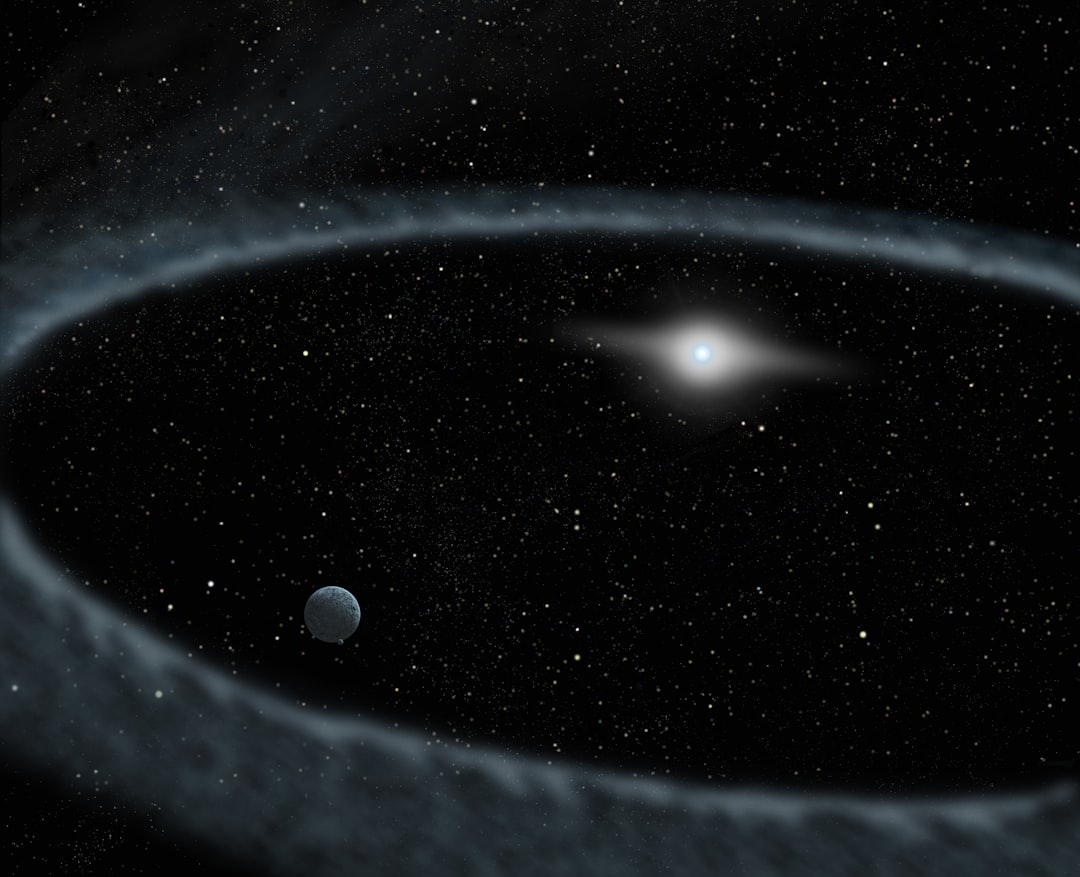
The Oort Cloud is a theoretical spherical region of icy bodies located at the outermost edge of our solar system. Dutch astronomer Jan Oort proposed its existence in 1950 based on observations of comet trajectories. This region is thought to contain a vast reservoir of comets and other small celestial objects.
Although the Oort Cloud cannot be directly observed with current technology, scientists infer its existence from the orbital patterns of long-period comets that originate from this distant area. These comets require thousands of years to complete a single orbit around the Sun and provide valuable information about the early solar system and its development. The Oort Cloud expands our understanding of the solar system’s structure.
While planets and their moons have been extensively studied, the Oort Cloud remains largely unexplored. Its existence indicates that the solar system extends considerably beyond the known planets into a region where gravitational forces from nearby stars and the Milky Way galaxy significantly influence celestial bodies. Ongoing scientific research into this distant region aims to reveal more about the solar system’s formation and evolution, as well as identify potential new celestial discoveries.
Key Takeaways
- The Oort Cloud is a distant, spherical shell of icy objects surrounding the solar system.
- It likely formed from leftover material after the solar system’s formation and contains comets and other small bodies.
- Observations of long-period comets provide indirect evidence of the Oort Cloud’s existence.
- The Oort Cloud plays a crucial role in supplying comets that occasionally enter the inner solar system.
- Future missions aim to directly explore the Oort Cloud to better understand its composition and influence on Earth.
Theoretical Origins and Composition of the Oort Cloud
The Oort Cloud is theorized to be composed primarily of icy bodies, including water ice, ammonia, methane, and other volatile compounds. These materials are remnants from the early solar system, formed during the same period as the planets. The prevailing theory suggests that the Oort Cloud formed from the leftover material that did not coalesce into planets or larger bodies.
As the solar system evolved, gravitational interactions with the giant planets, particularly Jupiter and Saturn, scattered these icy bodies into distant orbits, creating a spherical shell around the solar system. The Oort Cloud is divided into two distinct regions: the inner Oort Cloud and the outer Oort Cloud. The inner Oort Cloud is thought to be a denser region that extends from about 2,000 to 20,000 astronomical units (AU) from the Sun, while the outer Oort Cloud is more diffuse and extends from approximately 20,000 to 100,000 AU or even further.
This vast distance means that the Oort Cloud is incredibly difficult to study directly; it is estimated that one AU is about 93 million miles, or the distance from Earth to the Sun. The sheer scale of this region highlights both its significance in understanding solar system dynamics and the challenges faced by astronomers in gathering data about it.
The Oort Cloud, a theoretical cloud of icy bodies surrounding our solar system, plays a crucial role in understanding the origins of comets and the dynamics of our celestial neighborhood. For those interested in exploring how various natural phenomena can impact health, you might find a related article on the benefits of fruits for diabetes management insightful. You can read more about it here: Are Fruits Good for Diabetes?.
Probing the Oort Cloud: Observations and Discoveries

Despite its elusive nature, astronomers have made significant strides in understanding the Oort Cloud through indirect observations. One of the primary methods for studying this distant region involves tracking long-period comets that are believed to originate from the Oort Cloud. These comets often exhibit highly elliptical orbits that take them close to the Sun before they are ejected back into deep space.
By analyzing their trajectories and physical characteristics, scientists can infer properties about the Oort Cloud itself. In recent years, advancements in telescope technology have allowed astronomers to detect more distant objects that may belong to the Oort Cloud. For instance, surveys such as the Pan-STARRS (Panoramic Survey Telescope and Rapid Response System) have identified numerous trans-Neptunian objects (TNOs) that could be part of this distant reservoir. These discoveries have provided valuable data on the size distribution and composition of icy bodies in the outer solar system. Additionally, computer simulations have played a crucial role in modeling how these objects might behave under various gravitational influences, further enhancing our understanding of their origins and dynamics.
Oort Cloud’s Role in the Solar System
The Oort Cloud plays a pivotal role in shaping our understanding of solar system dynamics and evolution. It serves as a source of long-period comets that can provide insights into the early solar system’s conditions and processes. When these comets approach the Sun, they become visible from Earth and can be studied in detail.
Their compositions often reveal information about primordial materials that existed during the formation of the solar system, offering a glimpse into its history. Moreover, the gravitational interactions between objects in the Oort Cloud and nearby stars can lead to perturbations that send some of these icy bodies on trajectories toward the inner solar system. This process not only contributes to our understanding of cometary activity but also raises questions about potential impacts on Earth and other planets.
The study of these interactions helps scientists assess risks associated with near-Earth objects (NEOs) and develop strategies for planetary defense.
Potential Missions to Explore the Oort Cloud
| Metric | Value | Notes |
|---|---|---|
| Distance from Sun | 2,000 to 100,000 AU | 1 AU = distance from Earth to Sun (~150 million km) |
| Estimated Number of Comets | Trillions | Source of long-period comets |
| Shape | Spherical Shell | Surrounds the Solar System in all directions |
| Composition | Ice, rock, and dust | Similar to comet nuclei |
| Inner Boundary | ~2,000 AU | Also called the Hills Cloud |
| Outer Boundary | Up to 100,000 AU | Approximately 1.5 light-years |
| Temperature | ~10 K (-263 °C) | Extremely cold environment |
| Discovery | Hypothesized in 1950 | By Jan Oort to explain comet origins |
Exploring the Oort Cloud presents unique challenges due to its vast distance from Earth and its diffuse nature. However, several proposed missions aim to investigate this remote region more closely. One such concept involves sending a spacecraft equipped with advanced instruments capable of detecting and analyzing icy bodies within the Oort Cloud.
This mission would require innovative propulsion technologies to traverse the immense distances involved. Another intriguing proposal is to utilize gravitational assists from outer planets to increase spacecraft speed and efficiency during its journey to the Oort Cloud. By leveraging these gravitational interactions, a mission could potentially reach this distant region within a reasonable timeframe.
Such missions would not only enhance our understanding of the Oort Cloud but also provide opportunities for groundbreaking discoveries about cometary materials and their implications for planetary formation.
The Oort Cloud, a distant region of our solar system filled with icy bodies, plays a crucial role in our understanding of cometary origins and the early solar system’s formation. For those interested in exploring the philosophical implications of existence and consciousness, a fascinating article can be found that delves into these themes, which may offer a unique perspective on our place in the universe. You can read more about this intriguing connection in the article on Vaisesika philosophy here.
Oort Cloud’s Connection to Comets and Asteroids

The connection between the Oort Cloud and comets is one of its most fascinating aspects. Long-period comets are believed to originate from this distant region, where they remain dormant until perturbed by gravitational interactions with nearby stars or other celestial bodies. When these comets are nudged into orbits that bring them closer to the Sun, they become visible from Earth as they develop tails due to sublimation of their icy components.
In contrast to short-period comets, which originate from the Kuiper Belt—a region closer to Neptune—the long-period comets associated with the Oort Cloud can have highly elongated orbits that take them far beyond Pluto’s orbit. This distinction highlights not only different sources for these celestial objects but also varying evolutionary paths within our solar system. The study of these comets provides valuable insights into how material from different regions interacts and contributes to our understanding of planetary formation processes.
The Oort Cloud, a theoretical region of icy bodies surrounding our solar system, has long fascinated astronomers and astrophysicists alike. This distant area is believed to be the source of long-period comets that occasionally visit the inner solar system. Interestingly, the study of celestial phenomena often intersects with various cultural interpretations of the universe, as explored in an article on Indian aesthetics. This piece delves into the nature, philosophy, and multifaceted functions of art, offering a unique perspective on how different cultures perceive the cosmos. To read more about this intriguing connection, you can visit the article here.
Oort Cloud’s Influence on Earth’s History
The influence of the Oort Cloud on Earth’s history cannot be overstated. Throughout geological time, long-period comets originating from this distant region have impacted Earth and other celestial bodies within our solar system. These impacts can have profound effects on planetary environments, potentially influencing climate patterns and even contributing to mass extinction events.
For instance, it is hypothesized that some of Earth’s most significant extinction events may have been triggered by cometary impacts or near-misses that altered atmospheric conditions. The study of impact craters on Earth provides evidence for such events, allowing scientists to piece together a timeline of how these cosmic encounters have shaped our planet’s history.
The Future of Oort Cloud Exploration
As technology continues to advance, so too does our potential for exploring the mysteries of the Oort Cloud. Future missions aimed at this distant region could revolutionize our understanding of cometary science and solar system formation. With ongoing developments in propulsion systems, spacecraft design, and observational techniques, scientists are optimistic about uncovering new insights into this enigmatic area.
Moreover, international collaboration among space agencies could enhance mission capabilities and broaden our knowledge base regarding the Oort Cloud. By pooling resources and expertise, researchers can design missions that maximize scientific return while minimizing costs and risks associated with deep-space exploration. As we look ahead, it is clear that unraveling the secrets of the Oort Cloud will not only deepen our understanding of our own solar system but also contribute to broader questions about planetary systems throughout the universe.










+ There are no comments
Add yours