









Wormholes are fascinating theoretical constructs in the realm of physics, often described as shortcuts through spacetime. Imagine a tunnel connecting two distant points in the universe, allowing for instantaneous travel between them. This concept, while still largely speculative, has captured the imagination of scientists and the public alike. In essence, a wormhole could potentially allow for travel across vast distances in a fraction of the time it would normally take, making it a tantalizing possibility for interstellar exploration.
The term “wormhole” was coined by physicist John Archibald Wheeler in the 1950s, but the idea has roots that stretch back even further. Wormholes are often depicted as having two ends, each located at different points in spacetime. Theoretically, they could connect not just different locations in space but also different times, leading to intriguing implications for time travel. However, it’s important to note that these structures remain hypothetical and have yet to be observed or proven to exist.
Wormhole technology has garnered significant attention in recent years, particularly in the context of its potential to revolutionize communication and travel across vast distances. For those interested in exploring the philosophical implications of such advancements, a related article delves into Vedanta philosophy, examining the nature of reality and human existence. This insightful piece can be found at Vedanta Philosophy: Exploring the Nature of Reality and Human Existence, offering a thought-provoking perspective that complements discussions around the scientific possibilities of wormholes.
Key Takeaways
- Wormholes are hypothetical tunnels in spacetime that could potentially allow for faster-than-light travel and time travel.
- Einstein’s Theory of General Relativity provides the theoretical framework for the existence of wormholes, suggesting that they could be possible within the laws of physics.
- Wormholes have been a popular concept in science fiction and have appeared in various forms of popular culture, often depicted as shortcuts for interstellar travel.
- Scientists are actively searching for real wormholes in the universe, using advanced technology and astronomical observations to detect their presence.
- Studying wormholes presents significant challenges and limitations, including the need for exotic matter and the potential for instability.
Theoretical Framework: Einstein’s Theory of General Relativity
To understand wormholes, one must first grasp the principles of Einstein’s Theory of General Relativity. This groundbreaking theory, proposed in 1915, revolutionized our understanding of gravity and the fabric of spacetime. According to general relativity, massive objects like stars and planets warp the spacetime around them, creating what we perceive as gravitational attraction. This warping effect is crucial for the formation of wormholes.
Einstein’s equations suggest that under certain conditions, spacetime can be manipulated to create a tunnel-like structure. These solutions to his equations led to the theoretical possibility of wormholes. The most famous type is the Schwarzschild wormhole, which connects two black holes. However, this particular model is unstable and would collapse before anything could traverse it. More stable versions, like the traversable wormhole proposed by Kip Thorne and Michael Morris in 1988, require exotic matter with negative energy density to keep them open. This exotic matter remains purely theoretical and has not been discovered.
Wormholes in Science Fiction and Popular Culture
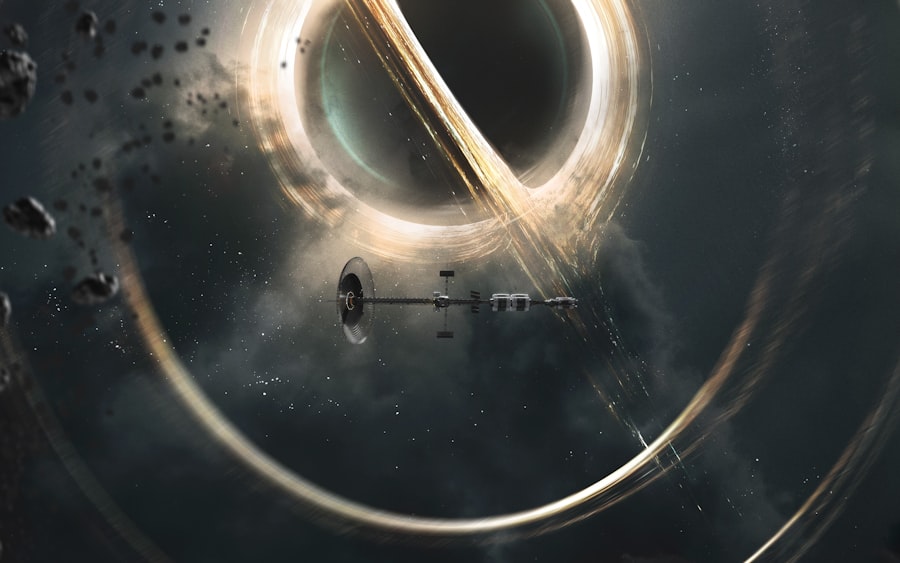
Wormholes have become a staple of science fiction literature and film, often serving as a plot device to facilitate time travel or interstellar journeys. From classics like “The Time Machine” by H.G. Wells to modern blockbusters like “Interstellar,” these cosmic shortcuts have sparked creativity and wonder.
In many stories, characters use wormholes to explore distant galaxies or even alternate realities, highlighting humanity’s desire to transcend the limitations of our physical existence. In popular culture, wormholes are often depicted with a sense of mystery and adventure. They are portrayed as swirling portals or gateways that can transport individuals across vast distances in an instant.
While these representations are often exaggerated for dramatic effect, they reflect our fascination with the unknown and the possibilities that lie beyond our current understanding of physics. The allure of wormholes taps into our innate curiosity about the universe and our place within it.
The Search for Real Wormholes

Despite their theoretical nature, scientists are actively searching for evidence of real wormholes in the universe. One approach involves studying gravitational waves—ripples in spacetime caused by massive cosmic events like colliding black holes. If wormholes exist, they might produce unique signatures detectable by instruments like LIGO (Laser Interferometer Gravitational-Wave Observatory). Researchers are keen to analyze data from these experiments for any anomalies that could hint at the presence of wormholes.
Another avenue of exploration is through astronomical observations. Scientists look for unusual phenomena that could suggest the existence of a wormhole, such as unexpected gravitational effects on nearby stars or light bending around invisible structures. While no definitive evidence has been found yet, advancements in technology and observational techniques continue to enhance our ability to probe the cosmos for signs of these elusive structures.
Wormhole technology has been a fascinating topic in the realm of theoretical physics, often drawing parallels to concepts in systems engineering. For those interested in exploring how complex systems can be modeled and understood, a related article on model-based systems engineering can provide valuable insights. You can read more about it in this article, which delves into the methodologies that help in structuring and analyzing intricate systems, much like the theoretical frameworks that underpin wormhole research.
Challenges and Limitations in Studying Wormholes
| Metrics | Data |
|---|---|
| Size | Variable, can be microscopic or large enough for a person to pass through |
| Formation | Not fully understood, theoretical concept in physics |
| Time Travel | Proposed as a theoretical possibility, but not proven |
| Stability | Dependent on theoretical properties of exotic matter and energy |
Studying wormholes presents numerous challenges and limitations, primarily due to their theoretical nature and the extreme conditions required for their existence. One significant hurdle is the need for exotic matter to stabilize a traversable wormhole.
As mentioned earlier, this type of matter has not been observed in nature, making it difficult to determine whether wormholes could ever be practical or real.
Additionally, even if wormholes do exist, they may be incredibly small or fleeting, making them hard to detect with current technology. The vastness of space adds another layer of complexity; even if a wormhole were nearby, finding it among the countless celestial bodies would be akin to searching for a needle in a cosmic haystack. These challenges underscore the speculative nature of wormhole research and highlight the need for continued advancements in both theoretical physics and observational capabilities.
Wormhole technology has been a fascinating topic in the realm of theoretical physics, offering intriguing possibilities for space travel and communication. For those interested in exploring related concepts, the article on orchid care provides an interesting analogy about nurturing growth and potential, much like how scientists nurture ideas in advanced fields. You can read more about this in the article on orchid care, which emphasizes the importance of proper conditions for flourishing.
Practical Applications of Wormholes
If wormholes could be harnessed for practical use, the implications would be profound. The most obvious application would be in space travel, allowing humanity to explore distant planets and galaxies without the constraints of conventional propulsion methods. This could revolutionize our approach to space exploration, making interstellar missions feasible within human lifetimes rather than requiring generations.
Beyond travel, wormholes could also have implications for communication across vast distances. Imagine being able to send information instantaneously across light-years using a wormhole as a conduit. This could transform how we communicate with spacecraft exploring distant worlds or even with potential extraterrestrial civilizations. While these applications remain speculative at this stage, they highlight the transformative potential that wormhole technology could offer if it were ever realized.
Ethical and Philosophical Considerations
The concept of wormholes raises several ethical and philosophical questions that merit consideration. For instance, if time travel were possible through a wormhole, what would be the implications for causality? Would altering events in the past create paradoxes or alternate timelines? These questions challenge our understanding of time and morality, prompting discussions about responsibility and the consequences of our actions.
Moreover, if humanity were to discover or create a stable wormhole, who would have access to it? The potential for unequal access raises concerns about power dynamics and exploitation. Would governments control this technology? How would it affect global relations? These ethical dilemmas highlight the need for careful consideration as we explore the possibilities presented by wormholes.
The Future of Wormhole Research
The future of wormhole research is both exciting and uncertain. As technology advances and our understanding of physics deepens, new avenues may open up for exploring these enigmatic structures. Ongoing research into quantum gravity and other fundamental theories may provide insights that bring us closer to understanding whether wormholes can exist in reality.
Moreover, interdisciplinary collaboration between physicists, astronomers, and engineers will be crucial in pushing the boundaries of our knowledge. As we continue to explore the cosmos and unravel its mysteries, the quest for understanding wormholes will likely remain a captivating frontier in science—a blend of theoretical inquiry and imaginative exploration that reflects humanity’s enduring curiosity about the universe we inhabit.










+ There are no comments
Add yours