







Gravitational lensing is a phenomenon that occurs when a massive object, such as a galaxy or cluster of galaxies, bends the light from a more distant object. This effect is a direct consequence of the warping of spacetime predicted by Einstein’s theory of general relativity. As light travels through the gravitational field of the massive object, its path is altered, resulting in multiple images, magnification, or distortion of the background object. Gravitational lensing serves as a powerful tool in modern astrophysics, allowing astronomers to study objects that would otherwise be too faint or too distant to observe directly.
The concept of gravitational lensing has gained significant attention since its first observational confirmation in the 1970s. It has since become an essential aspect of cosmology and astrophysics, providing insights into the distribution of dark matter, the expansion of the universe, and the nature of distant celestial objects. By analyzing the light from lensed objects, researchers can glean information about both the lensing mass and the background source, making gravitational lensing a unique intersection of observational and theoretical astrophysics.
Gravitational lensing is a fascinating phenomenon that not only provides insights into the distribution of dark matter in the universe but also enhances our understanding of the fundamental principles of physics. For those interested in exploring the philosophical implications of scientific advancements, a related article discussing the development of rationalism through the works of Descartes, Spinoza, and Leibniz can be found at this link. This article delves into how the rationalist tradition has shaped modern scientific thought, including concepts that underpin theories like gravitational lensing.
Key Takeaways
- Gravitational lensing occurs when massive objects bend light, confirming predictions of general relativity.
- Observations of gravitational lensing provide evidence for dark matter and the large-scale structure of the universe.
- There are multiple types of gravitational lensing, including strong, weak, and microlensing, each with unique observational features.
- Gravitational lensing is a powerful tool for studying distant galaxies, dark matter distribution, and cosmological parameters.
- Despite challenges like data interpretation and observational limits, future research promises deeper insights into the cosmos through improved lensing techniques.
The Theory of General Relativity and Gravitational Lensing
Albert Einstein’s theory of general relativity, published in 1915, fundamentally changed our understanding of gravity. Rather than viewing gravity as a force acting at a distance, Einstein proposed that massive objects cause a curvature in spacetime, which affects the motion of other objects. This curvature leads to the bending of light as it passes near a massive body, a prediction that would later be confirmed through various observations. Gravitational lensing is one of the most striking manifestations of this theory, illustrating how mass influences the path of light.
The mathematical framework of general relativity describes how light follows geodesics, or the shortest paths in curved spacetime. When light from a distant star passes near a massive object like a galaxy, the curvature caused by that galaxy alters the trajectory of the light. Depending on the alignment of the observer, lensing mass, and background source, this can result in various observable effects, such as multiple images or arcs. The degree of bending is determined by both the mass of the lensing object and its distance from the observer and the source.
Observational Evidence of Gravitational Lensing
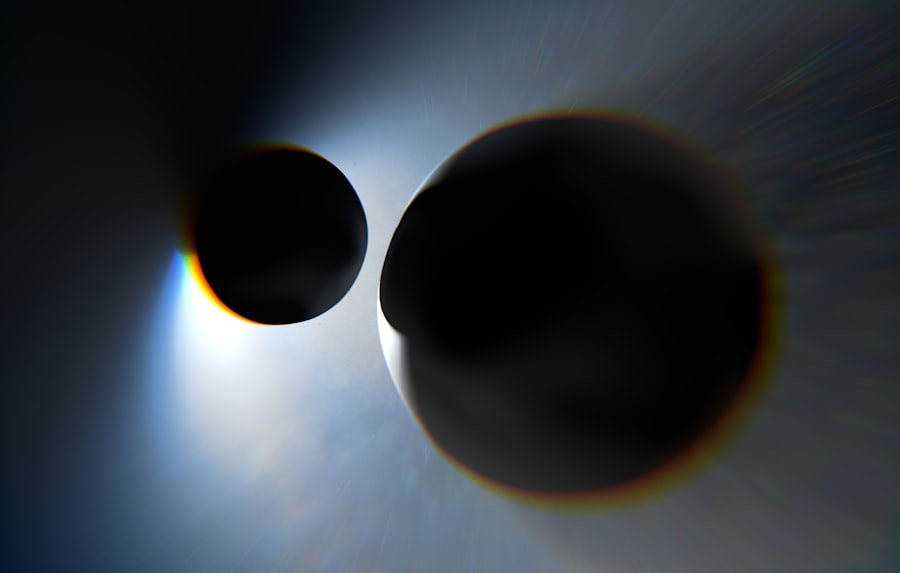
The first strong evidence for gravitational lensing came in 1979 with the discovery of the double quasar Q0957+561. Astronomers observed two images of the same quasar separated by a small angular distance, which was attributed to the gravitational influence of a foreground galaxy. This observation not only confirmed Einstein’s predictions but also opened up new avenues for research in cosmology.
Since then, numerous examples of gravitational lensing have been documented, ranging from individual galaxies to massive clusters. Observational techniques have evolved significantly over the years, enhancing our ability to detect and analyze gravitational lensing events. Advanced telescopes equipped with sensitive detectors can capture faint light from distant sources, allowing astronomers to identify lensed objects even at great distances.
Surveys such as the Hubble Space Telescope‘s Frontier Fields and the Sloan Digital Sky Survey have provided extensive data on gravitational lenses, revealing complex structures and enabling detailed studies of dark matter distribution in galaxy clusters.
Types of Gravitational Lensing

Gravitational lensing can be categorized into three primary types: strong lensing, weak lensing, and microlensing. Strong lensing occurs when there is a precise alignment between the observer, lensing mass, and background source. This alignment results in prominent features such as multiple images or highly distorted arcs. Strong lensing is particularly useful for studying massive objects like galaxy clusters and provides valuable information about their mass distribution.
Weak lensing, on the other hand, involves slight distortions in the shapes of background galaxies due to the gravitational influence of foreground structures. While these distortions are subtle and often require statistical analysis to detect, weak lensing is instrumental in mapping dark matter on large scales. By analyzing the shapes and orientations of numerous background galaxies, astronomers can infer the presence and distribution of unseen mass in the universe.
Microlensing is a different phenomenon that occurs when a compact object, such as a star or planet, passes in front of a more distant source. This type of lensing results in temporary brightness increases in the background object as its light is focused by the foreground object’s gravity. Microlensing has been used to detect exoplanets and study dark matter candidates like primordial black holes.
Gravitational lensing is a fascinating phenomenon that not only provides insights into the distribution of dark matter but also enhances our understanding of the universe’s structure. For those interested in exploring the philosophical implications of how we perceive reality, a related article discusses various theories of truth, which can deepen our appreciation of the complexities involved in interpreting astronomical observations. You can read more about these theories in the article found here.
Applications of Gravitational Lensing in Astronomy
| Metric | Description | Typical Values |
|---|---|---|
| Einstein Radius | Angular radius of the ring image formed by perfect alignment of source, lens, and observer | 0.1 to 10 arcseconds |
| Lens Mass | Mass of the object causing the gravitational lensing effect | 10^10 to 10^15 solar masses |
| Redshift of Lens (z_l) | Redshift of the lensing object | 0.1 to 1.0 |
| Redshift of Source (z_s) | Redshift of the background source being lensed | 0.5 to 10 |
| Magnification Factor | Ratio of lensed image brightness to unlensed source brightness | 1 to 100+ |
| Time Delay | Difference in arrival time of light between multiple lensed images | Days to months |
| Image Separation | Angular distance between multiple lensed images | 0.5 to 5 arcseconds |
Gravitational lensing has numerous applications in astronomy that extend beyond merely confirming general relativity. One significant application is in the study of dark matter. By analyzing how light is bent around galaxy clusters, astronomers can map out dark matter distributions that are otherwise invisible. This has led to important insights into the structure and evolution of galaxies and clusters over cosmic time.
Additionally, gravitational lensing allows for the study of distant galaxies that would be too faint to observe directly. The magnification effect can make these distant objects more accessible for detailed analysis. For instance, lensed galaxies can provide information about star formation rates and chemical compositions at various epochs in cosmic history. Furthermore, gravitational lensing has been employed to measure cosmic distances more accurately through techniques like time-delay cosmography, which uses variations in brightness between multiple images to estimate distances.
Gravitational lensing is a fascinating phenomenon that not only provides insights into the distribution of dark matter but also enhances our understanding of the universe’s structure. For those interested in exploring related topics, the article on the diversity and classification of bacteria and viruses offers a unique perspective on how different scientific fields can intersect. You can read more about it in this article, which highlights key characteristics and types of microorganisms, showcasing the vastness of scientific inquiry.
Challenges and Limitations in Studying Gravitational Lensing
Despite its advantages, studying gravitational lensing presents several challenges and limitations. One major issue is related to modeling the mass distribution of lensing objects accurately. The presence of dark matter complicates these models since it does not emit light and can only be inferred through its gravitational effects. Misestimating mass distributions can lead to incorrect conclusions about both the lensing object and the background source.
Another challenge lies in distinguishing between different types of lensing effects.
In crowded fields with multiple potential lenses or overlapping sources, it can be difficult to determine which object is responsible for a particular lensing event.
Additionally, observational biases may affect data collection; for example, certain types of lensed objects may be more easily detected than others due to their brightness or alignment with foreground masses.
Future Prospects for Gravitational Lensing Research
The future of gravitational lensing research looks promising with advancements in technology and observational techniques. Upcoming telescopes like the James Webb Space Telescope (JWST) are expected to enhance our ability to observe distant galaxies and their interactions with foreground masses. The JWST’s infrared capabilities will allow astronomers to probe deeper into cosmic history and study lensed objects that were previously inaccessible.
Moreover, large-scale surveys such as the Vera Rubin Observatory’s Legacy Survey of Space and Time (LSST) will provide vast amounts of data on gravitational lenses across different cosmic epochs. These surveys will enable researchers to refine models of dark matter distribution and improve our understanding of galaxy formation and evolution. As computational techniques advance, simulations will also play an increasingly important role in interpreting observational data and predicting new lensing phenomena.
The Impact of Gravitational Lensing on our Understanding of the Universe
Gravitational lensing has significantly impacted our understanding of the universe by providing insights into fundamental questions about dark matter, cosmic structure, and galaxy evolution. It serves as a natural laboratory for testing theories of gravity and offers unique observational opportunities that enhance our knowledge of distant celestial phenomena. As research continues to evolve with new technologies and methodologies, gravitational lensing will likely remain a central focus in astrophysics.
The implications of gravitational lensing extend beyond mere observation; they challenge existing paradigms and encourage new theories about the nature of matter and energy in the universe. By bridging theoretical predictions with empirical evidence, gravitational lensing exemplifies how fundamental physics can illuminate our understanding of complex cosmic processes. As we continue to explore this fascinating phenomenon, it will undoubtedly yield further revelations about the universe’s structure and its underlying principles.








+ There are no comments
Add yours