









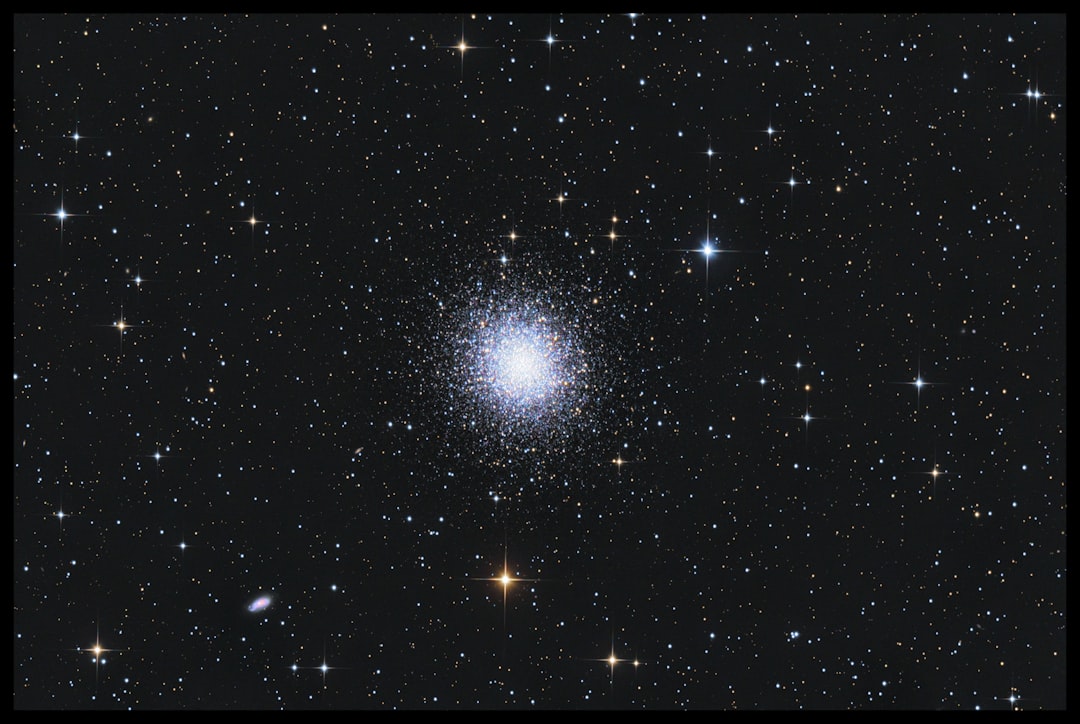
Globular clusters are dense collections of stars that orbit the core of galaxies. They are typically spherical in shape and contain hundreds of thousands to millions of stars, all bound together by their mutual gravitational attraction. These clusters are among the oldest astronomical objects in the universe, with ages often exceeding 10 billion years. They are primarily found in the halos of galaxies, including our Milky Way, and are distinct from open clusters, which are younger and less densely packed.
The stars within globular clusters are generally older and have low metallicity, indicating that they formed early in the universe’s history when heavier elements were less abundant. This characteristic makes them valuable for studying the early stages of stellar evolution and the conditions present in the early universe. Their compact nature and relative uniformity also make globular clusters ideal laboratories for astrophysical research, allowing astronomers to investigate stellar dynamics, evolution, and the formation of galaxies.
Globular clusters are fascinating astronomical structures that provide insights into the early universe and the formation of galaxies. For a deeper understanding of the logical frameworks used in astronomical research, you might find the article on logical appraisal and reasoning particularly enlightening. It explores how logical consistency plays a crucial role in interpreting complex data, much like the analysis of globular clusters in astrophysics. You can read more about this topic in the article here: Understanding Logical Appraisal, Inconsistency, and Reasoning.
Key Takeaways
- Globular clusters are dense, spherical collections of ancient stars orbiting galaxies.
- They form early in a galaxy’s history and evolve through complex stellar interactions.
- Composed mainly of old, metal-poor stars, globular clusters have unique chemical signatures.
- They provide insights into galactic evolution and the distribution of dark matter.
- Ongoing research explores their dynamics, potential exoplanets, and future observational opportunities.
Formation and Evolution of Globular Clusters
The formation of globular clusters is a complex process that is still not fully understood. Current theories suggest that they may have formed from the gravitational collapse of gas clouds in the early universe. As these clouds cooled and condensed, they created dense regions where stars could form. Over time, these stars would cluster together due to their gravitational interactions, leading to the formation of a globular cluster.
Once formed, globular clusters undergo significant evolutionary changes. Initially, they contain a mix of stars at various stages of their life cycles. However, as time progresses, more massive stars evolve quickly and end their lives in supernova explosions, while lower-mass stars can remain on the main sequence for billions of years. This process leads to a gradual change in the cluster’s composition, with the more massive stars being replaced by lower-mass stars. Additionally, interactions between stars can lead to phenomena such as mass segregation, where heavier stars move toward the center of the cluster while lighter stars drift outward.
Characteristics and Composition of Globular Clusters
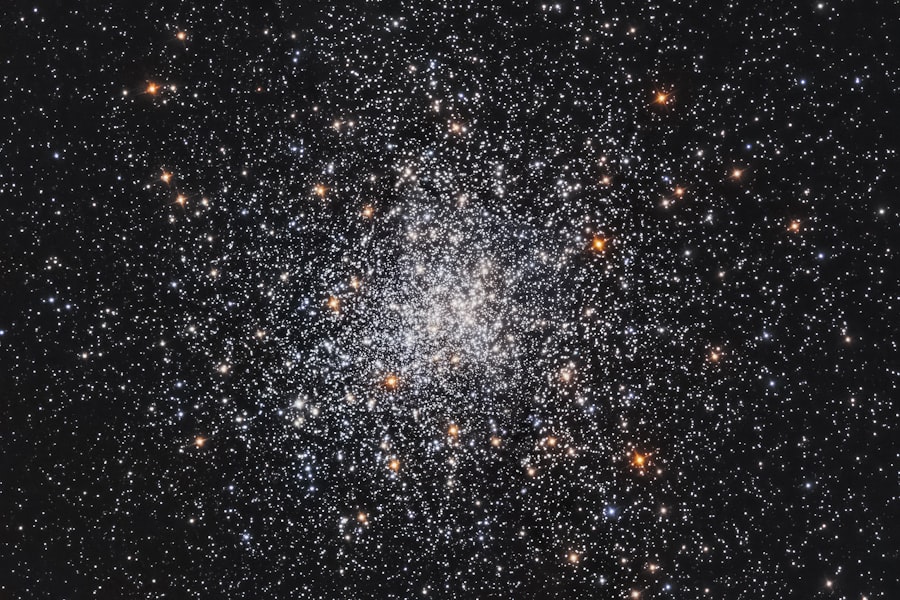
Globular clusters exhibit several defining characteristics that set them apart from other stellar groupings. One notable feature is their high stellar density, particularly in the core regions, where stars can be packed closely together. This density can lead to dynamic interactions among stars, including close encounters and even mergers.
The gravitational binding energy of these clusters is substantial, allowing them to maintain their structure over billions of years. In terms of composition, globular clusters are primarily made up of older stars that are predominantly Population II stars. These stars have low metallicity, which means they contain fewer elements heavier than hydrogen and helium.
This low metallicity is indicative of their formation during an era when the universe was still young and had not yet produced significant amounts of heavy elements through stellar nucleosynthesis. The presence of various stellar types within globular clusters, including red giants and horizontal branch stars, provides insights into stellar evolution and the life cycles of stars.
The Role of Globular Clusters in Galactic Evolution
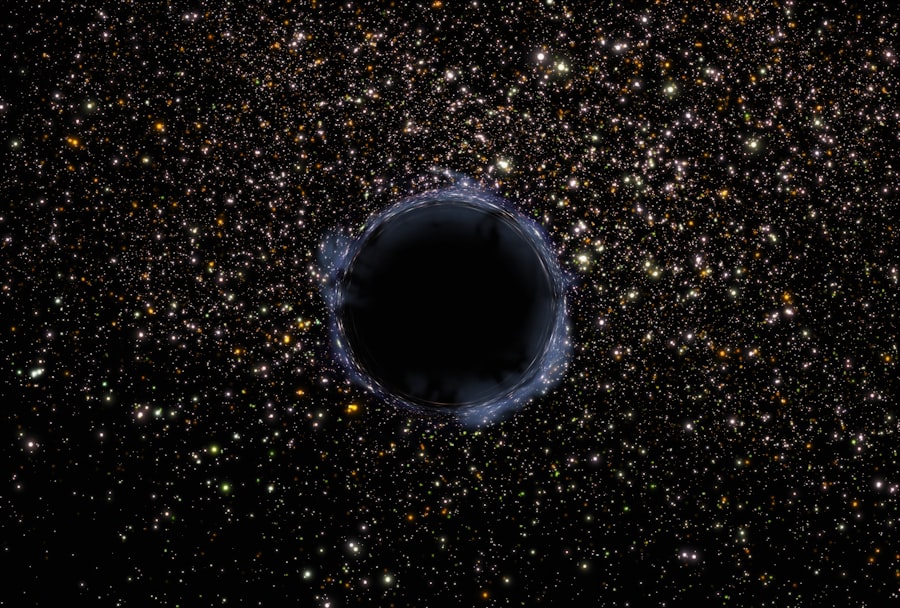
Globular clusters play a significant role in our understanding of galactic evolution. They serve as relics from the early universe, providing clues about the conditions that existed during the formation of galaxies. By studying these clusters, astronomers can gain insights into the processes that shaped galaxies over cosmic time scales.
Moreover, globular clusters can influence the dynamics of their host galaxies. Their gravitational interactions with surrounding stars and gas can affect star formation rates and contribute to the overall mass distribution within a galaxy. Additionally, as globular clusters orbit through a galaxy’s halo, they can interact with dark matter and other structures, further influencing galactic evolution. The study of globular clusters thus offers a window into both the history and future of galaxies.
Globular clusters are fascinating astronomical structures that contain tightly packed groups of stars, often found in the halos of galaxies. These clusters are not only important for understanding stellar evolution but also provide insights into the formation of galaxies themselves. For those interested in the broader implications of studying celestial objects, a related article discusses the significance of standardized testing in higher education, which can be seen as a parallel to the rigorous methods used in astronomical research. You can read more about this topic in the article on the differences between GRE and TOEFL exams here.
The Mystery of Globular Cluster Dynamics
| Metric | Value | Unit | Description |
|---|---|---|---|
| Typical Diameter | 10-30 | parsecs | Average size range of globular clusters |
| Number of Stars | 10,000 – 1,000,000 | stars | Estimated number of stars contained in a globular cluster |
| Age | 10-13 | billion years | Typical age range of globular clusters |
| Distance from Galactic Center | 5,000 – 100,000 | light years | Range of distances globular clusters are found from the center of the Milky Way |
| Metallicity [Fe/H] | -2.5 to -0.5 | dex | Range of metal content relative to the Sun, indicating old stellar populations |
| Core Density | 10^3 – 10^6 | stars per cubic parsec | Density of stars in the core region of a globular cluster |
| Velocity Dispersion | 5 – 20 | km/s | Typical range of stellar velocity dispersion within globular clusters |
The dynamics of globular clusters present intriguing challenges for astrophysicists. The behavior of stars within these dense environments is governed by complex gravitational interactions that can lead to unexpected phenomena. For instance, the high stellar density in the cores of globular clusters can result in frequent close encounters between stars, leading to phenomena such as binary star formation or even the ejection of stars from the cluster.
One area of active research involves understanding how these dynamics affect the overall structure and evolution of globular clusters. Observations have shown that many globular clusters exhibit signs of core collapse, where the central region becomes increasingly dense over time.
This process raises questions about how long globular clusters can maintain their stability and what factors might lead to their eventual dissolution or transformation into other structures.
Exoplanets and Globular Clusters
The search for exoplanets within globular clusters has gained interest in recent years as astronomers seek to understand whether these ancient star systems can host planetary bodies. While most exoplanet discoveries have been made around younger stars in open clusters or field stars, globular clusters present unique challenges due to their dense stellar environments.
The high stellar density in globular clusters may influence planet formation processes. For instance, interactions between stars could disrupt protoplanetary disks or lead to increased rates of stellar encounters that might affect planetary stability. Despite these challenges, some studies have suggested that planets could exist within globular clusters, particularly around lower-mass stars that are more stable over long periods.
The Search for Dark Matter in Globular Clusters
Globular clusters also play a role in the ongoing search for dark matter, an elusive component that makes up a significant portion of the universe’s mass-energy content. The dynamics observed within globular clusters can provide insights into the distribution and properties of dark matter in galactic halos.
By studying the motion of stars within globular clusters, astronomers can infer the presence of unseen mass that contributes to their gravitational binding. The behavior of these stars can reveal discrepancies between observed mass and expected mass based on visible matter alone, suggesting the influence of dark matter. This research is crucial for understanding not only globular clusters but also the broader structure and evolution of galaxies.
The Future of Studying Globular Clusters
The study of globular clusters is poised for significant advancements in the coming years due to improvements in observational technology and theoretical modeling. Next-generation telescopes and instruments will enable astronomers to probe deeper into these ancient star systems, uncovering new details about their composition, dynamics, and potential for hosting exoplanets.
Additionally, ongoing research into the relationship between globular clusters and dark matter will continue to shed light on fundamental questions about the universe’s structure.
As our understanding evolves, globular clusters will remain key subjects for exploring stellar evolution, galactic dynamics, and cosmological phenomena.
Their enduring presence in our universe ensures that they will continue to be a focal point for astronomical research for years to come.











+ There are no comments
Add yours